Benchling Bioanalytical
Bioanalytical labs often work across disconnected systems, turning work that should take minutes into days or even weeks. We partnered with Merck to build something that could fix that, using Benchling's existing Bioprocess platform as the starting point.
I led design alongside a group PM and senior engineer, trying to answer one overarching question: could a platform built for a different scientific workflow extend to this use case? Through on-site research and design sprints back home, we found where the existing model could be used or extended, and where it needed something new. That included a status lifecycle for lab tests that didn't exist before, and a way to design physical plate layouts that the original Bioprocess model couldn't handle.
We launched with Merck, our charter partner, in August 2025.
- Role
- Design lead
- Timeline
- 2024–2025
- Team
- 4 designers, 5 eng teams
- Skills
- Design Leadership, UX Research, Interaction Design
10X
efficiency gain
25%
reduction in manual tasks
3
expansion or new customer opportunities
1.1M
samples supported, with six legacy systems phased out
Source: axendia.com
A complex, disjointed process
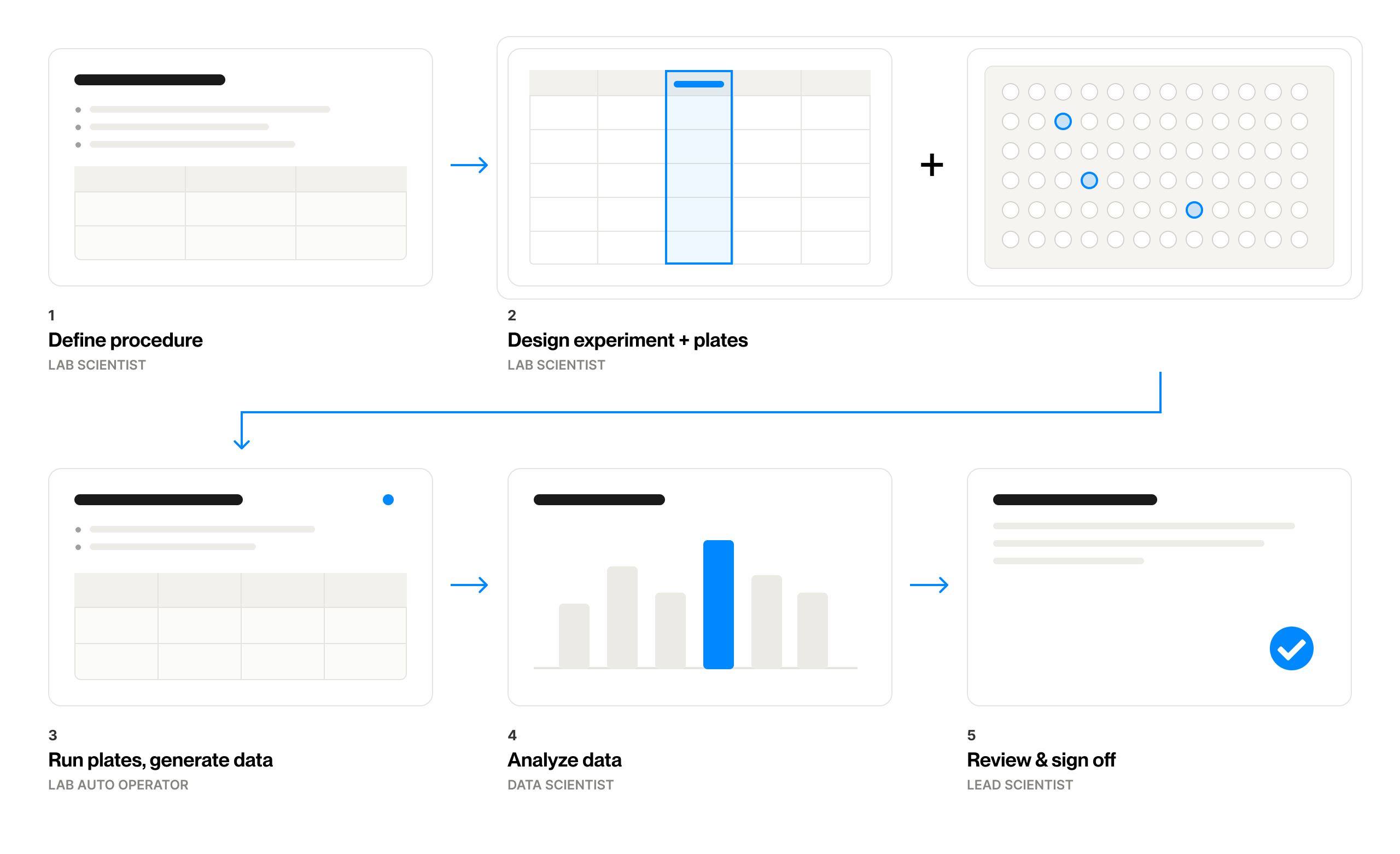
During drug development, scientists develop assays (or colloquially, lab tests) that can detect and measure things. They repeat the following process many times until they have everything understood, documented, and ready to execute.
After they're developed, these assays are run over thousands of samples. The workflow shifts towards importing, testing, and re-testing them using specific business logic (e.g. if result > x, re-test at dilution y).
Manual handoffs erode trust
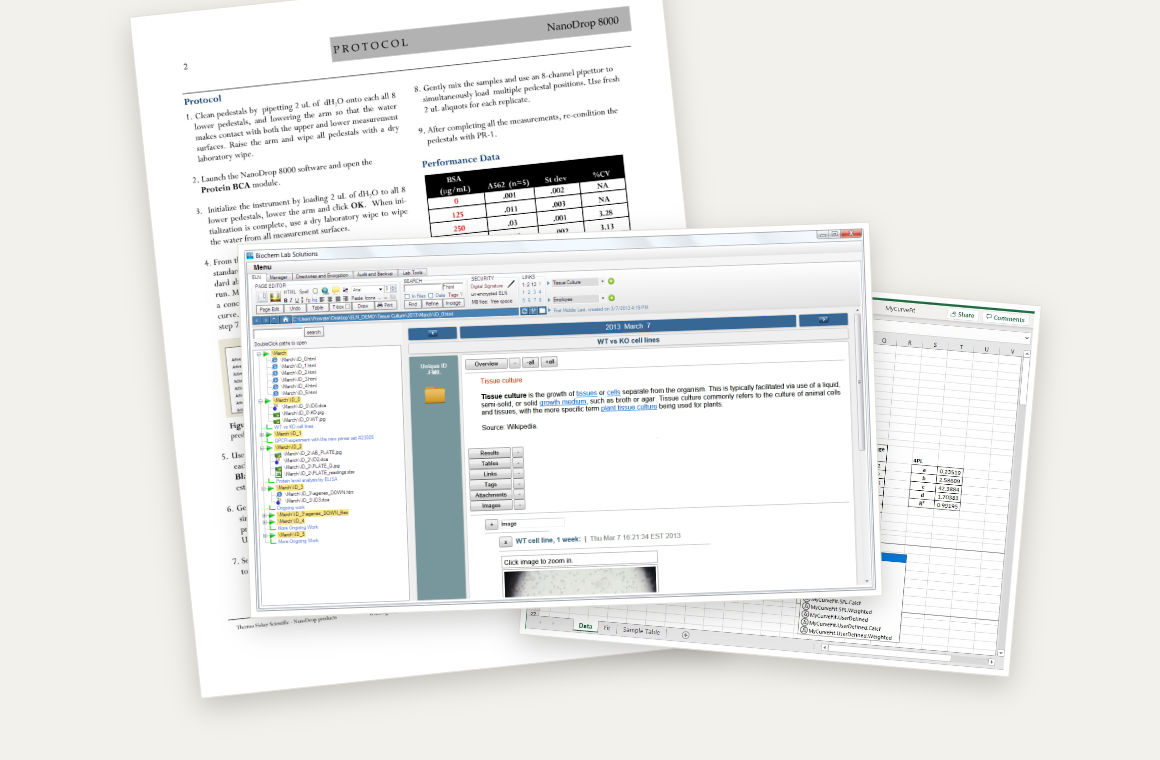
Like many large enterprises, Merck's systems were a patchwork of legacy software, custom tools and paper documentation. Scientists used up to nine systems to do their job, and their notebook was so slow that they often waited hours to transcribe their work.
It was tempting to look at their Windows 95-era software and conclude that Benchling's UX would be drastically better, but in reality, their systems were purpose-built for their workflow. Just because it looks better doesn't mean it works better. Our platform is known for being highly configurable and flexible, but that can become a liability when customers need a solution that works out of the box and maps cleanly to real-world sample testing.
Finding the edges of the existing model
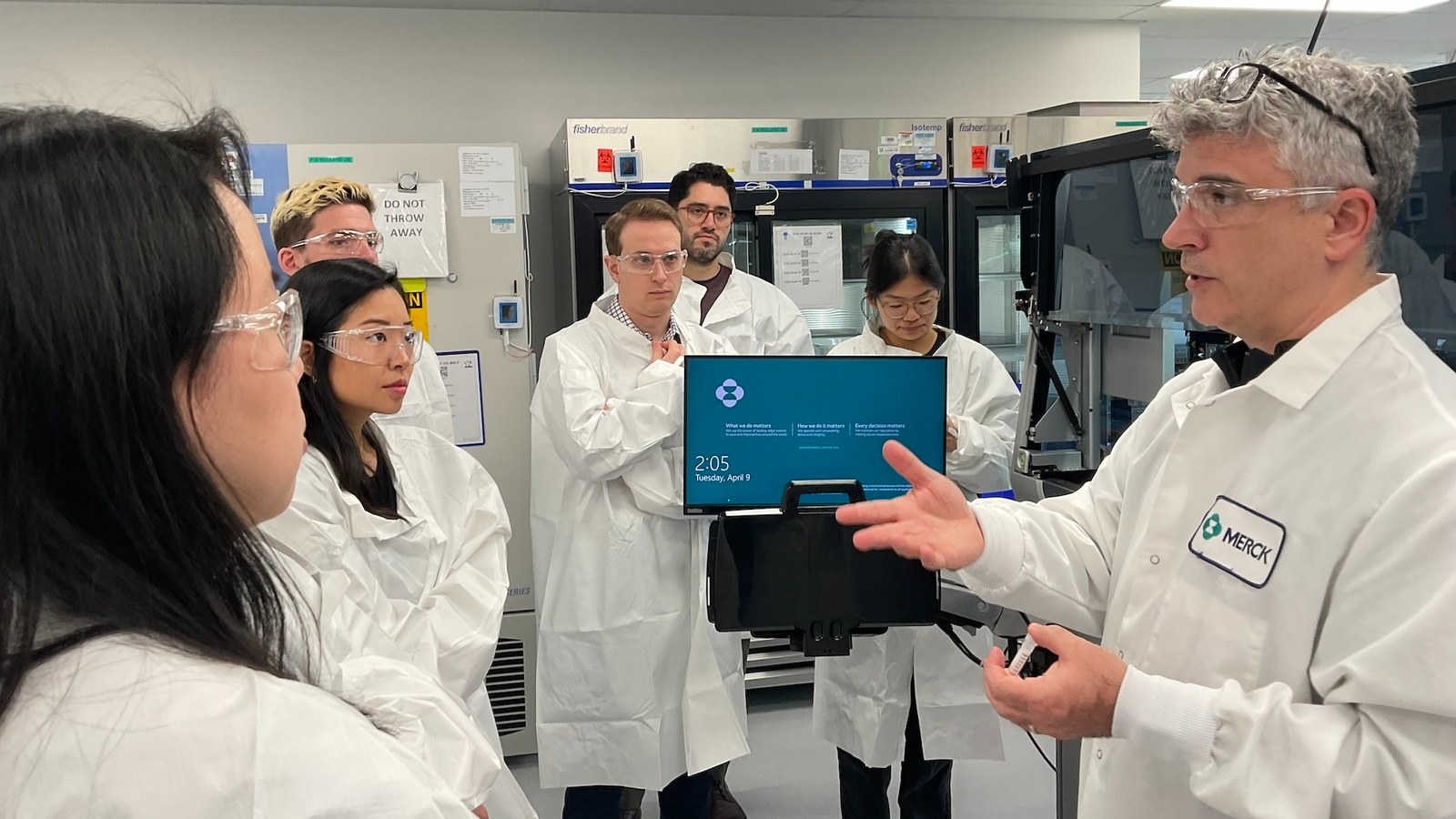
I saw my role as a translator between Merck and Benchling, converting their dense scientific language to Benchling concepts that our team could understand. There was an overwhelming amount of context that Merck's scientists shared, so we had to be disciplined about what we shared and how with our internal stakeholders.
We created user journeys and personas, but what really helped was having a clear mapping between their data model and ours, their conceptual model and our own system's models. It helped us align on what we were even talking about before we started designing UIs.
Building on the Bioprocess platform
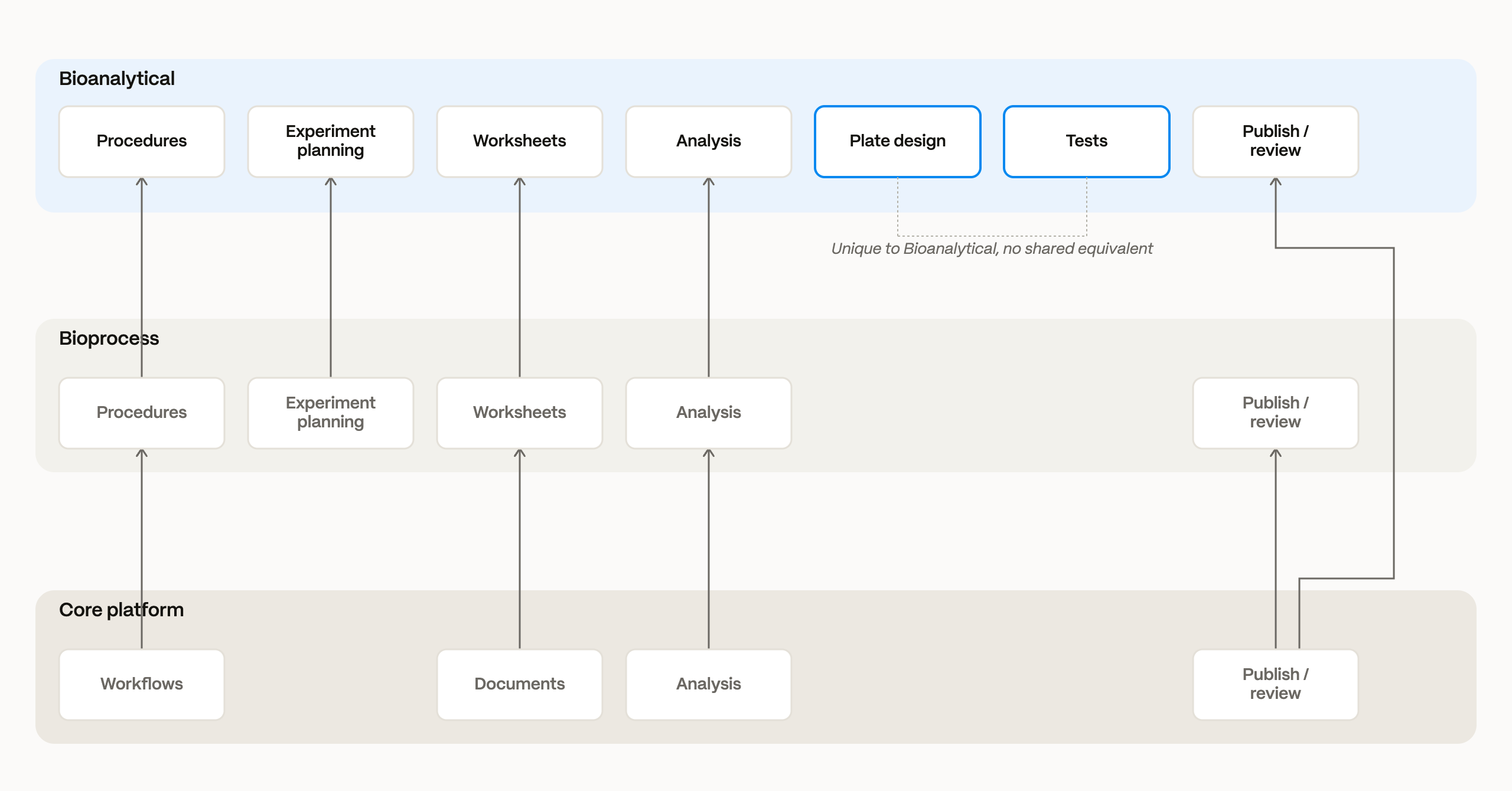
Our thinking was strongly shaped by a technical decision to build Bioanalytical on a shared foundation with another new product, Benchling Bioprocess.
On paper, the idea made sense. In both cases, scientists need to design processes through experimentation and then execute them under tight control. Bioprocess focuses on producing materials, Bioanalytical focuses on testing them.
This gave us leverage, but came with constraints. Our guiding questions centered around this tension:
Does our platform's conceptual model align with how scientists think and work?
Does this concept deserve to become a first-class object? Does reusing our existing systems break things downstream?
If we can't build the whole thing, what's the smallest piece that still solves the problem?
I'll focus on two key areas where this came up: plate designs and testing workflows.
Plates: a mismatched interaction model
Bioanalytical work centers around "plates," small plastic blocks with tiny wells, whereas Bioprocess leans on physical containers called "bioreactors."
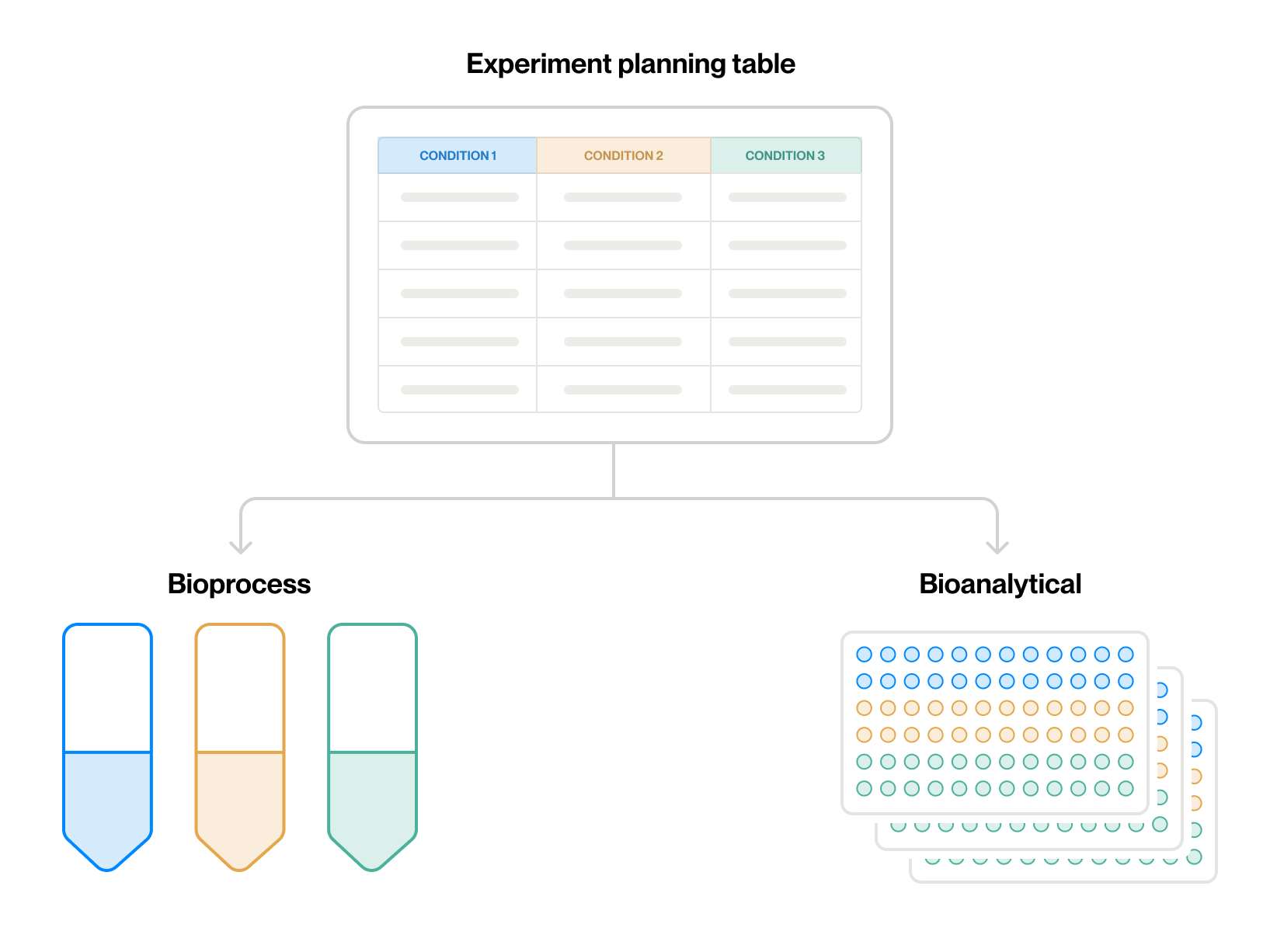
This matters because it changes how scientists think about experiment plans. Bioprocess relied on a giant table, where each column was a "condition," which basically represented a single bioreactor.
Plates broke this model, with complex mappings between the column's parameters and a physical plate. Conceptually, a single column could map to specific wells in a single plate or span multiple.
We couldn't really rework or swap out the table, since it was wired into everything downstream: experimentation creation, run execution, data analysis. Everyone, including myself, wanted to avoid forking the codebase and maintaining two versions, if possible.
Designing plates where the work happens
I partnered with my teammate, who'd recently picked up where another designer left off. They'd left us with some prior concepts which were a solid start, but hadn't considered how plates could plug into a completely new product area. It'd been planned as a legacy notebook feature, simplifying some of the build, but also constraining what we might realistically be able to ship.
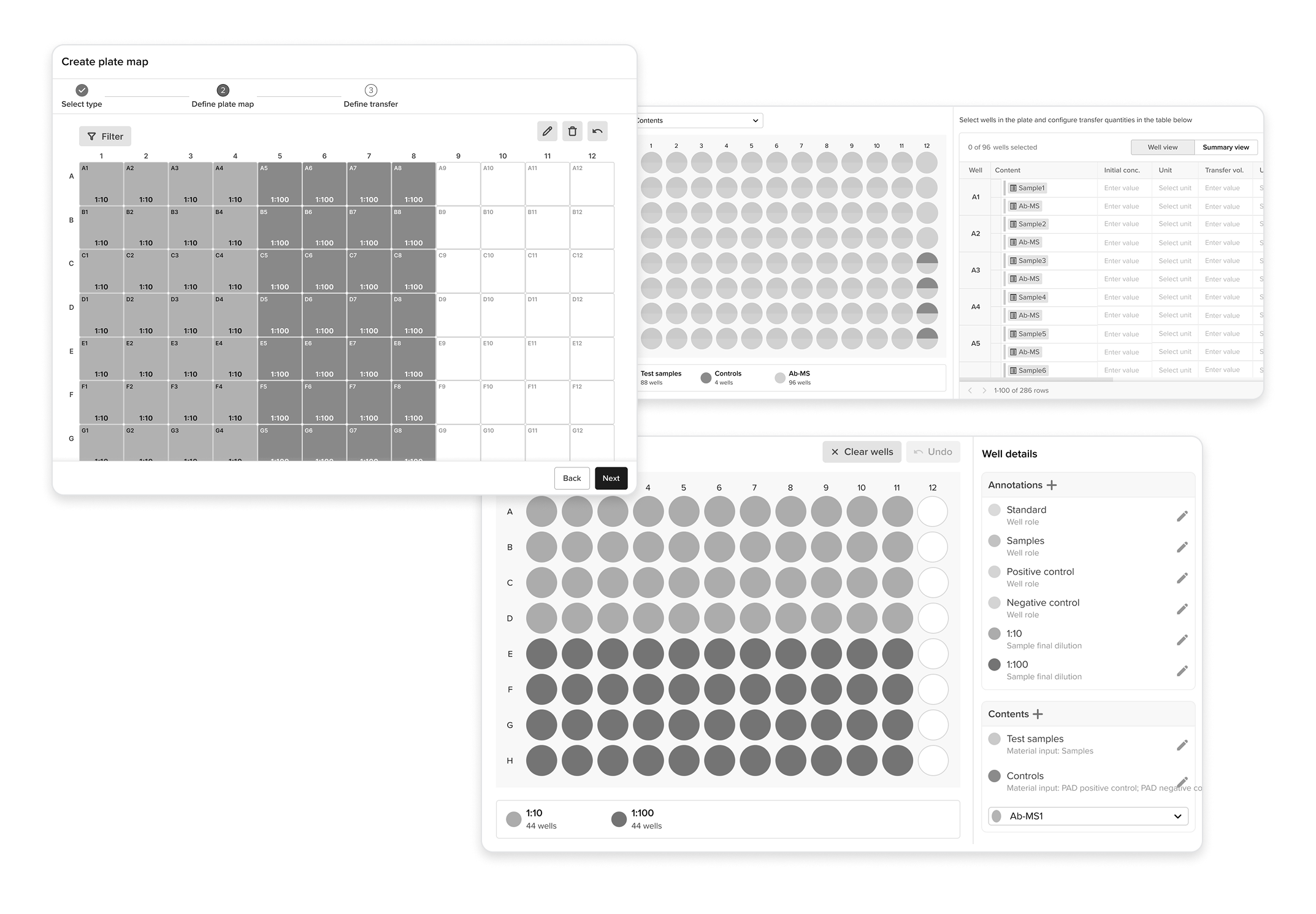
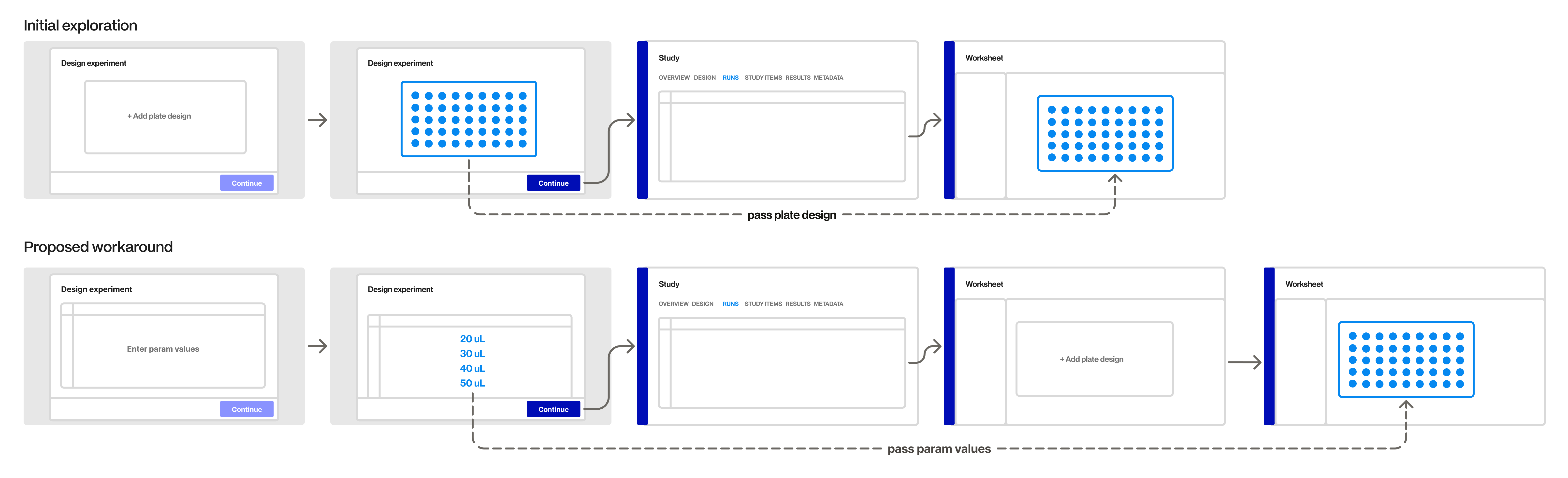
Given that scientists use both tables and plates during experiment planning, my teammate and I explored inserting plate design as a third step in the flow.
It was well-received, but the integration would be costly. An alternative was what I called the "split path." The user partially fills out the table, navigates a few steps, and then designs the plates in the experiment's worksheets. It was inelegant, but it still gave scientists the functionality and flexibility to run their experiments. Here, the need for instant, clean data overrode UI polish.
Tests: stress-testing our task data model
Once an assay is finalized, it needs to be run in a tightly controlled sample testing workflow. During a clinical study, the system needs to automatically assign tests to samples and help scientists find, test, and re-test them until the final results look acceptable.
At first glance, it seemed like we had the existing building blocks in place, but this fell apart on closer examination.
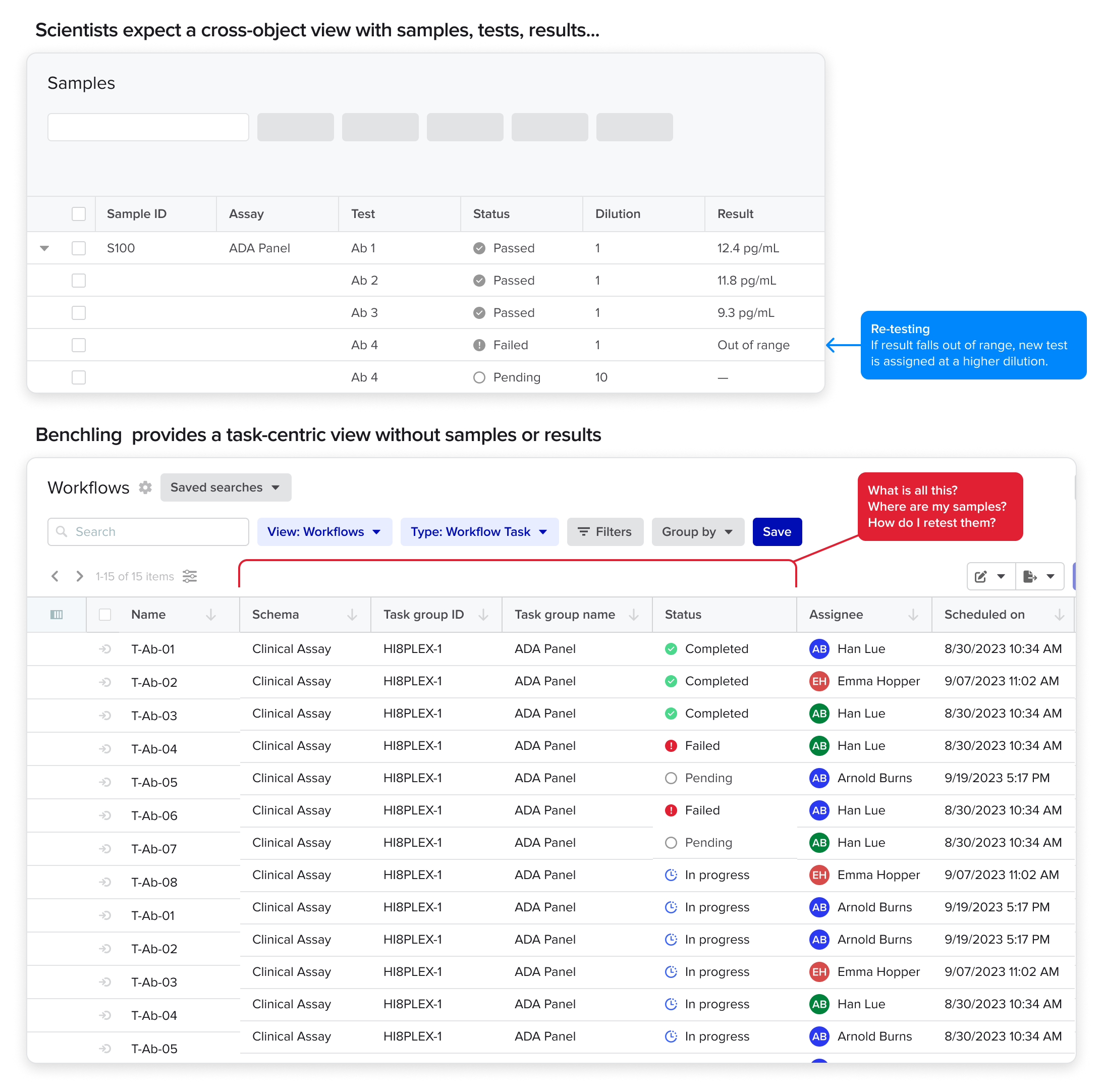
Yikes. Our workflow engine was built to handle team-to-team requests, like requesting a sample from another lab. But test ordering needed things the workflow system didn't do: automatically assigning tasks to samples on receipt, tracking status through result evaluation, and encoding re-test conditions so a failed result could spawn a new task with the right parameters.
We circled around this problem for a while, scarred by a history of releasing features with unclear boundaries and overlapping use cases. Everyone wanted to avoid creating a duplicative, workflow-like thing for a single use case.
Proposing a new test object
My PM and I sketched out the shape of a proposed "test" object with a status lifecycle.
We tried to distill the solution to its most essential parts. Other legacy systems had status lifecycles for samples and results, but if we built only this, users could still find the samples they needed. More importantly, they could get results almost instantaneously, where their current system made them wait. When we compared the two options, we agreed that the test object approach was the right one.
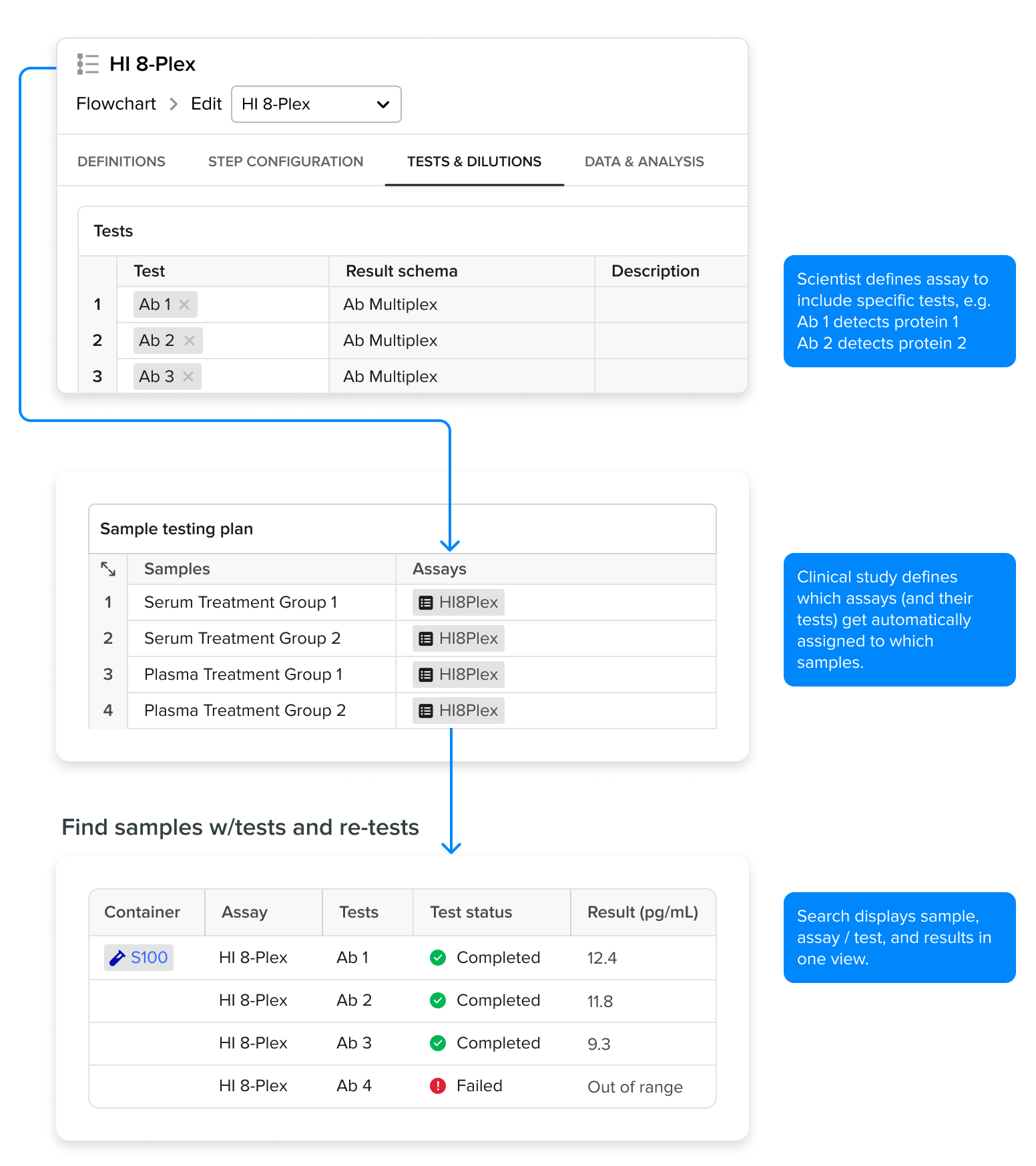
From plate design to test results
Plates
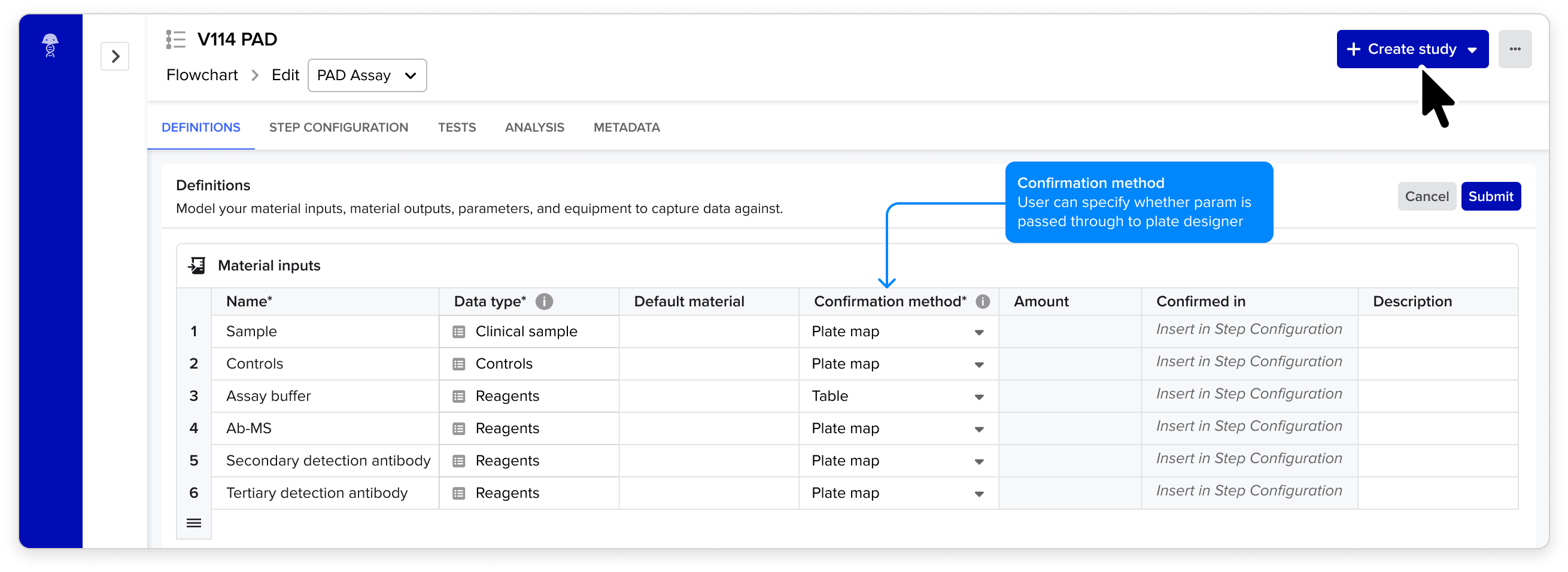
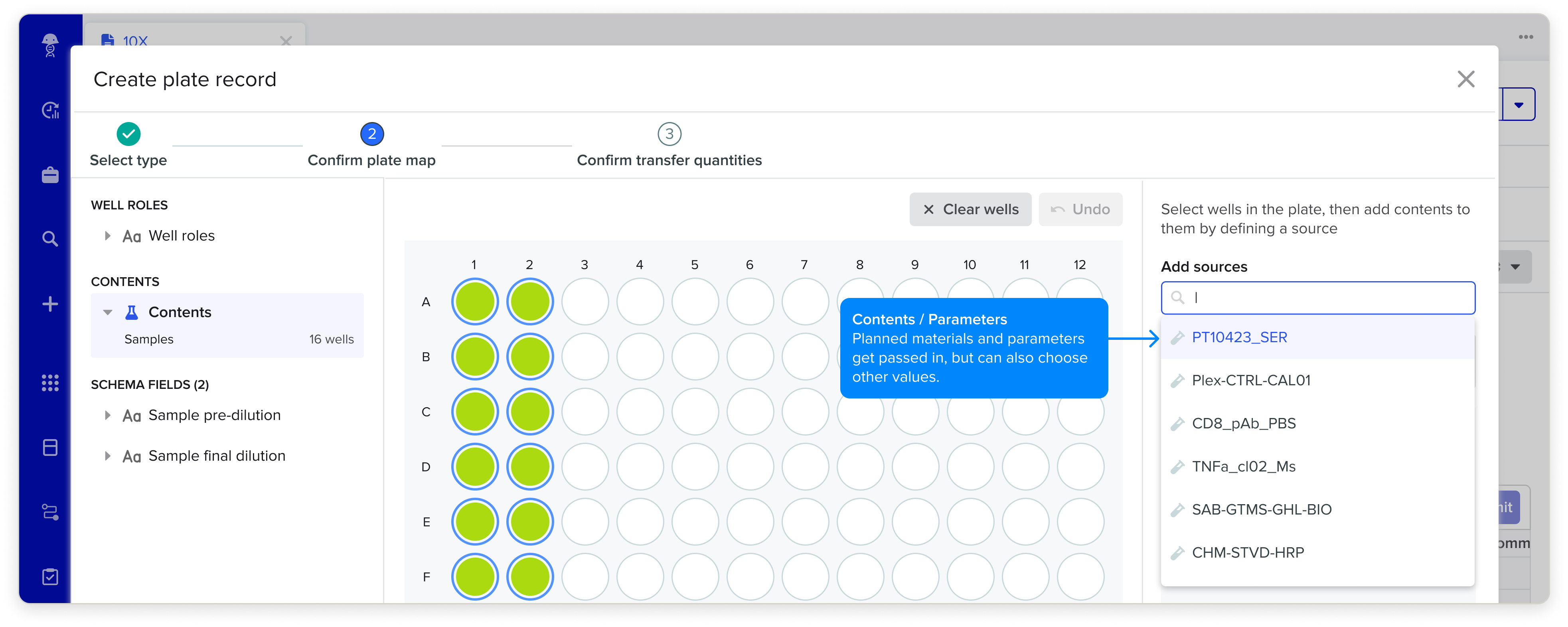
We added the concept of a "confirmation method," which tells our system what values should be passed down to a plate by default. Scientists can override them later during experiment planning.
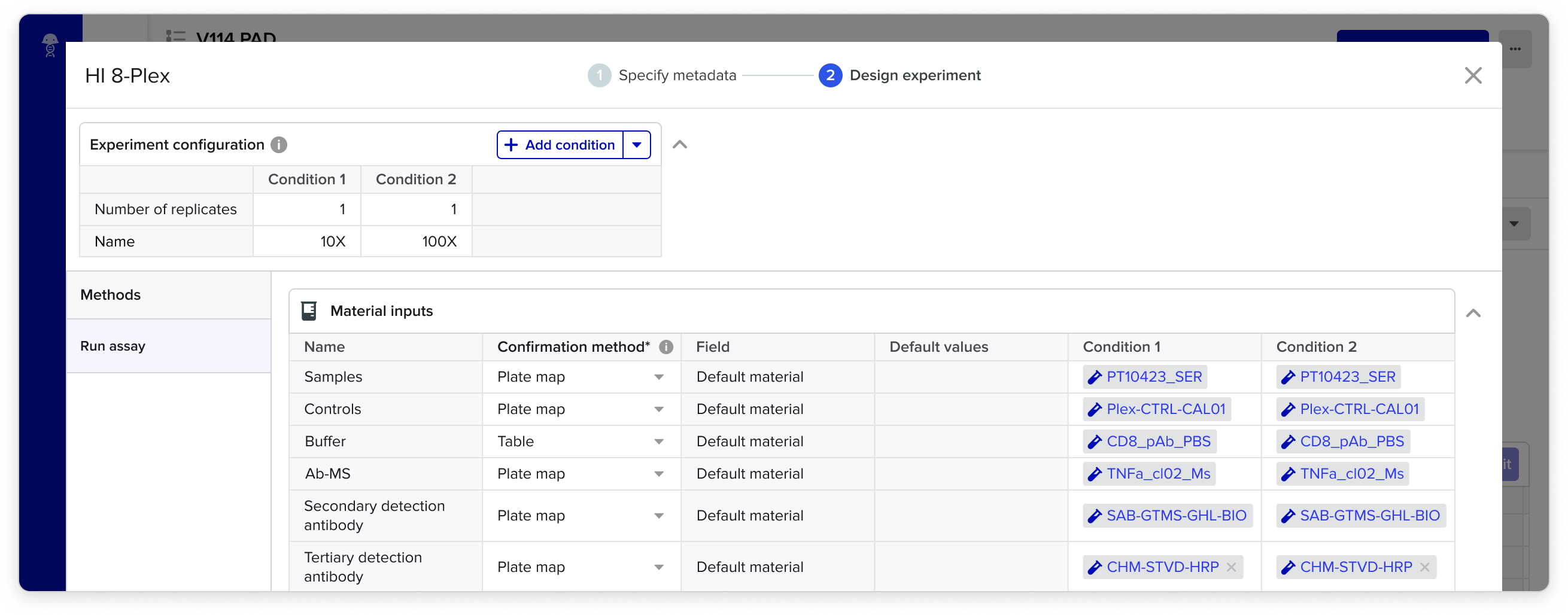
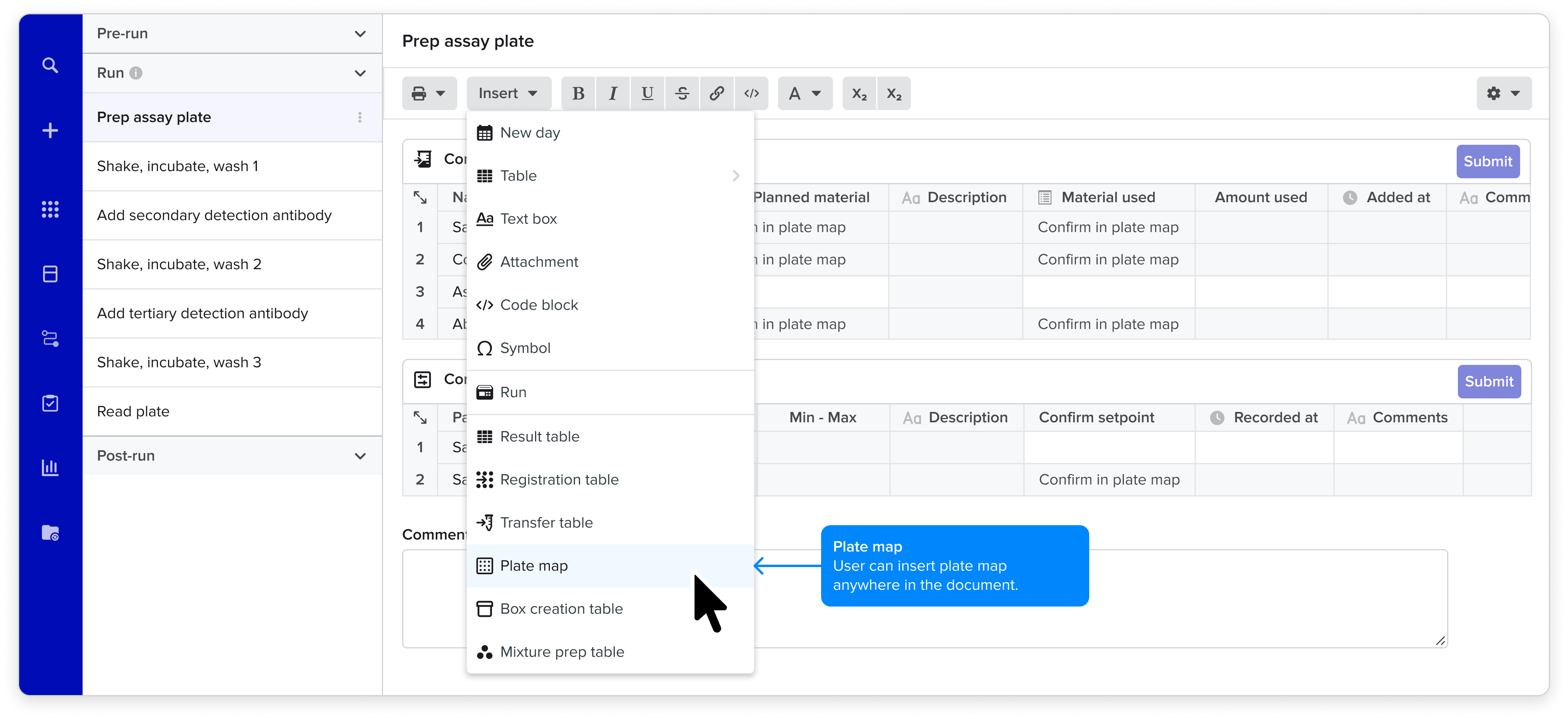
Afterwards, scientists can insert plates wherever they'd like. They're still trying to figure out what the final assay procedure should be, so speed and flexibility are key.
In the plate designer, the experiment's parameters are passed through. Scientists can use them here or add new values, if any come to mind.
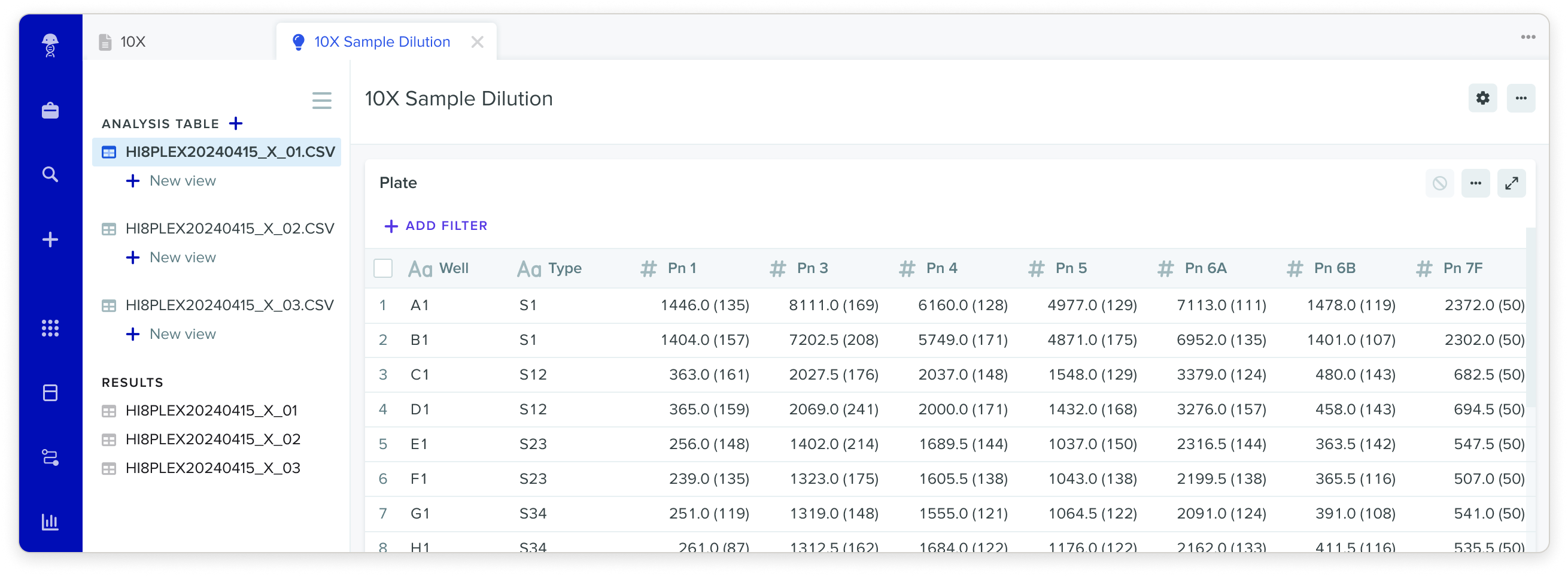
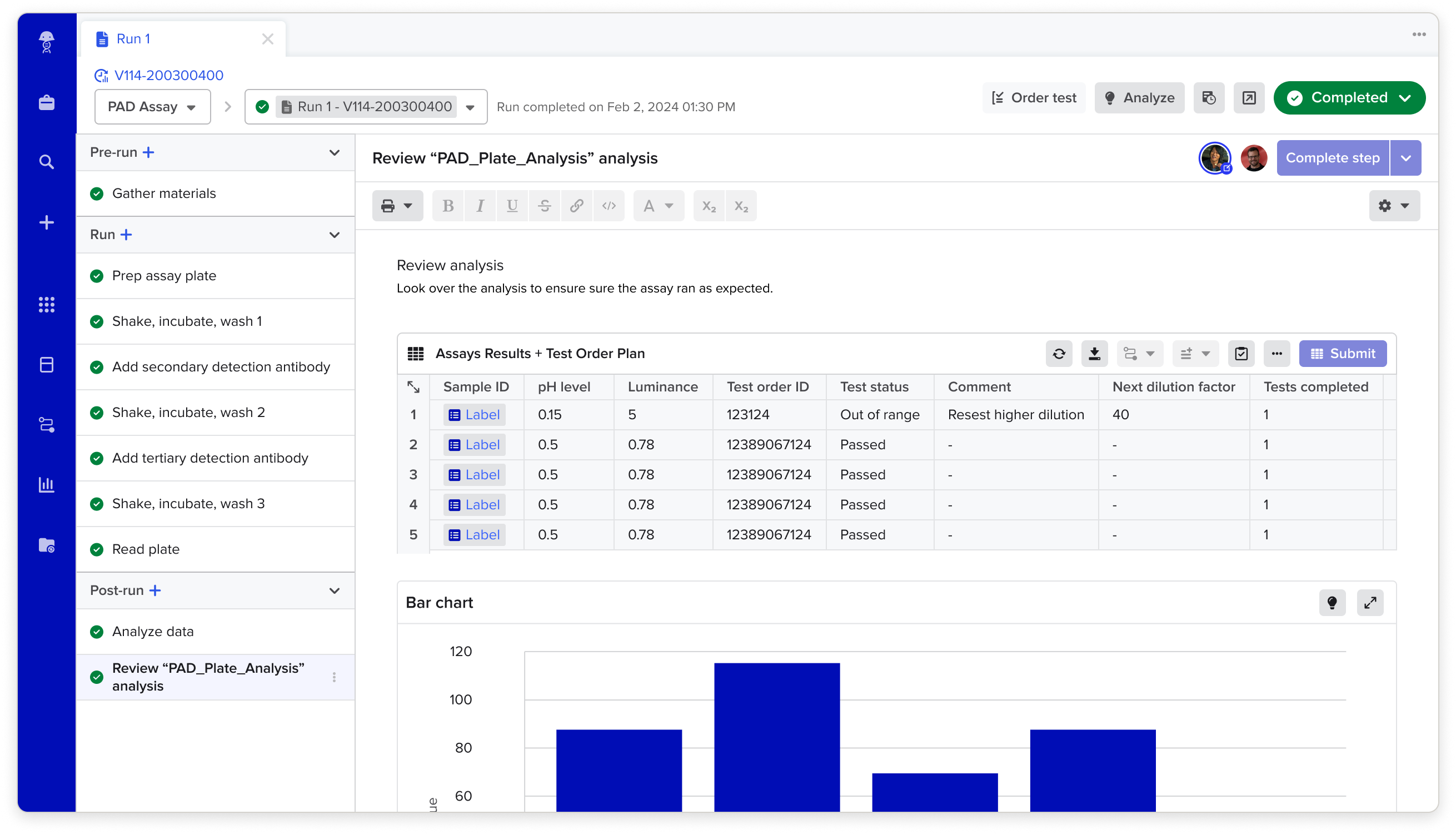
Finally, they can send all their data to analysis. Everything gets joined together cleanly and results are generated within moments.
Tests
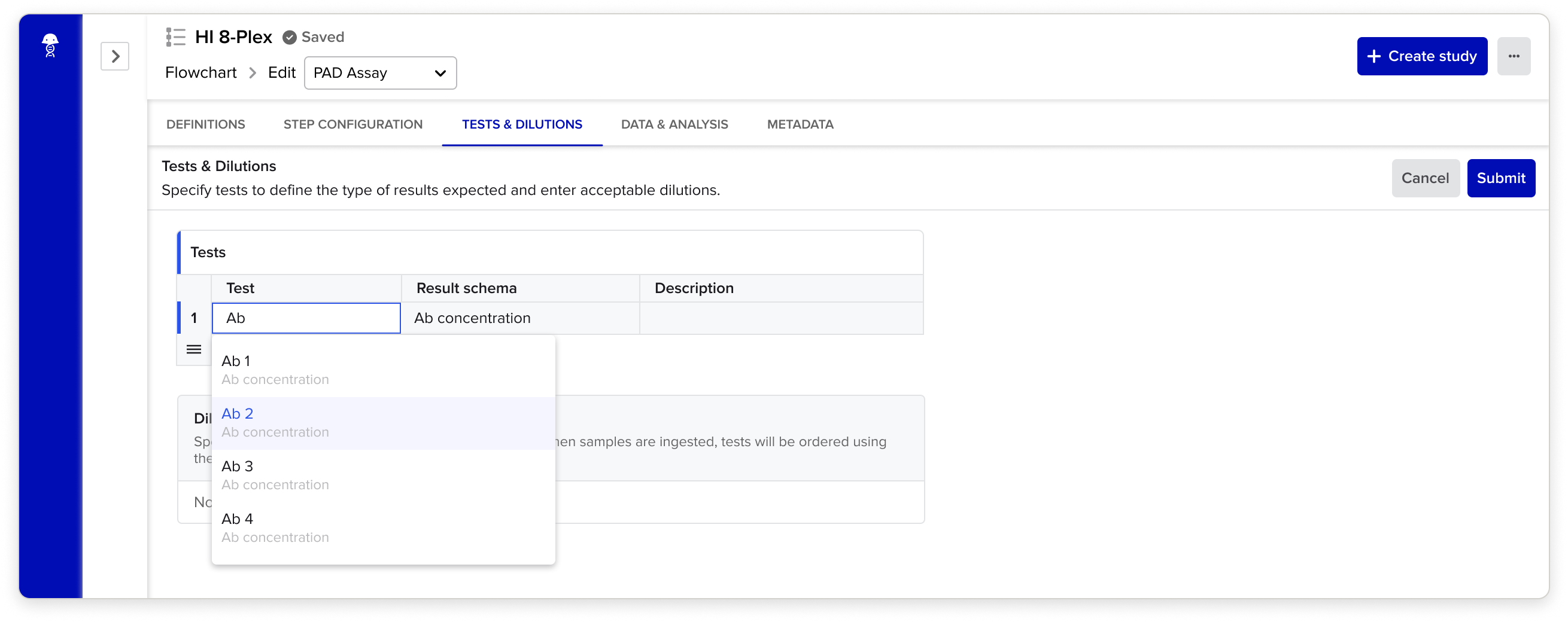
Here we jump ahead to after the assay is finalized. An admin defines tests and links them to the assay.
Clinical study administrators specify which samples are expected and how they should be tested.
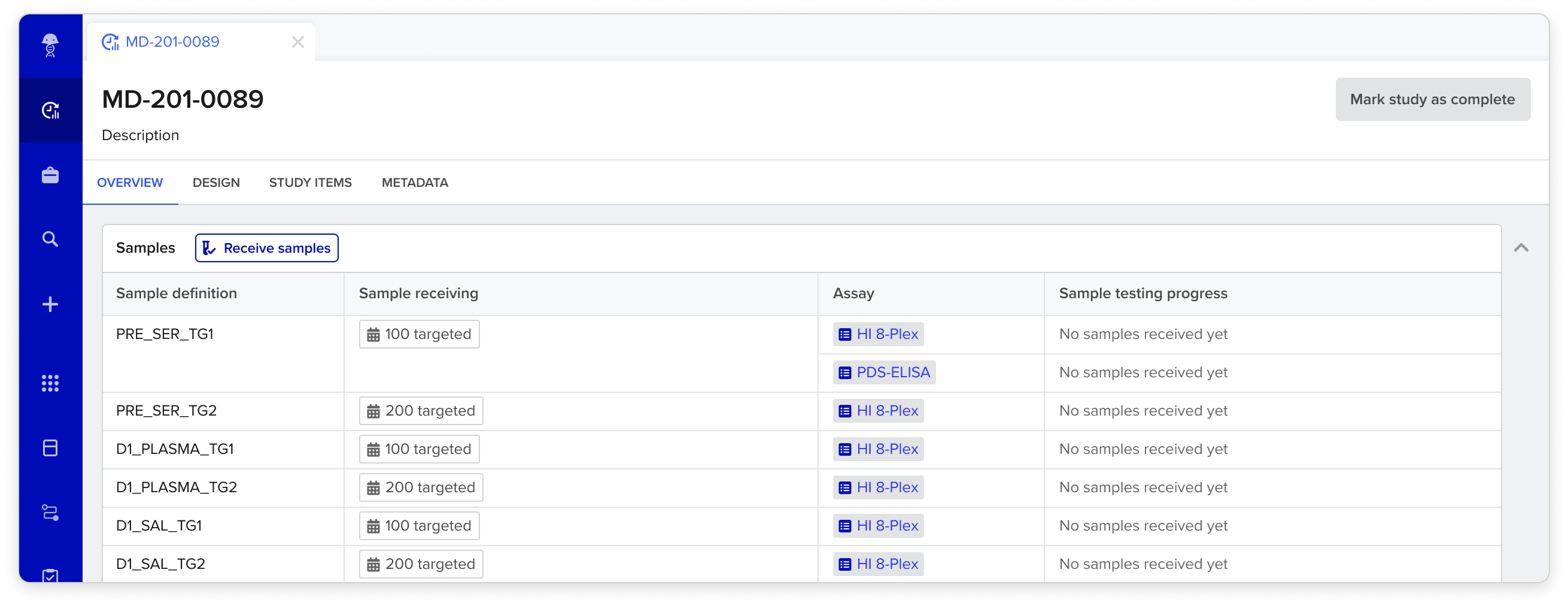
Samples are created with tests associated, with a status lifecycle and instructions on how they'll be re-tested. When results fall out of range, new tests are assigned and tracked alongside the original.
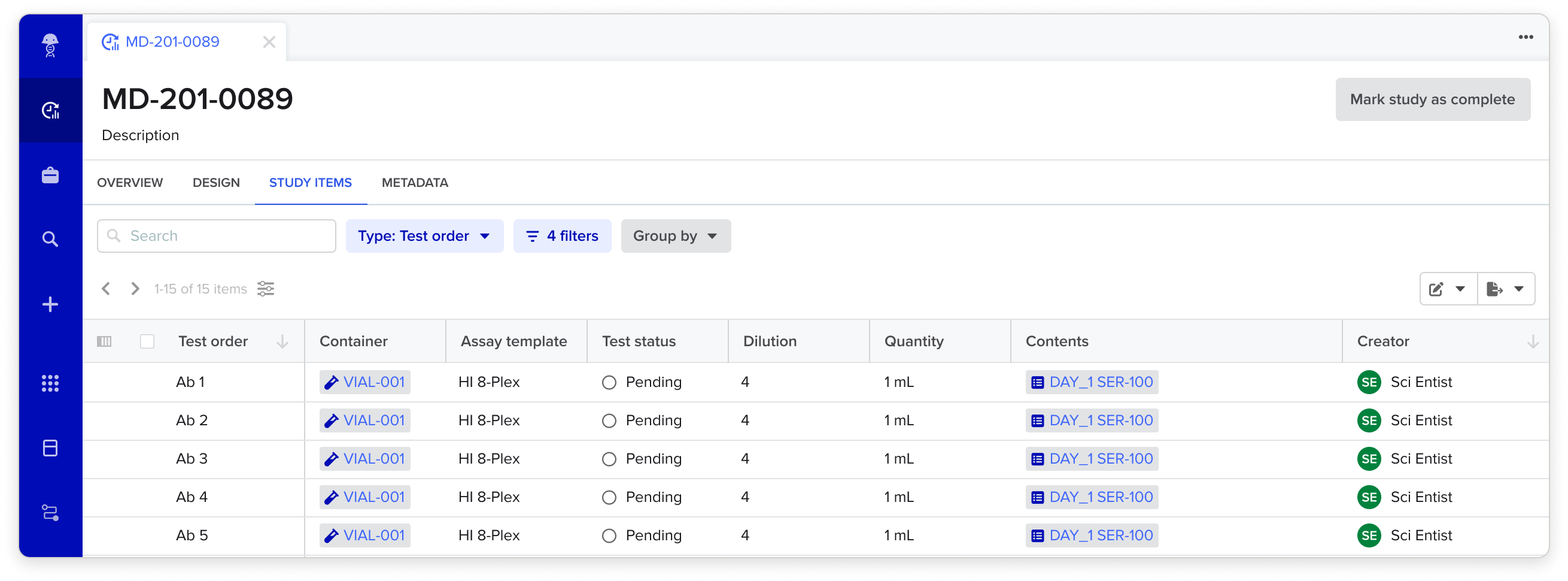
All work is captured as structured data which can be reviewed and audited, with complete traceability from start to finish.
Shipped, validated, and expanded
After months of work and weeks of rigorous user acceptance testing, we saw Merck go live with a public announcement and 400 users onboarded.
10X
efficiency gain
25%
reduction in manual tasks
3
expansion or new customer opportunities
1.1M samples
supported, with six legacy systems phased out
Other teams within Merck started asking about Benchling, with expansion opportunities following the successful partnership. With no sales effort, Bioanalytical picked up two more prospects purely through word-of-mouth. One deal got far enough along to validate the whole approach and was on track to close by the time I left Benchling.
Our dashboards showed more than just logins, too: scientists were running more experiments per user over time. Combined with what we were hearing qualitatively, it signaled real adoption: Merck scientists were working this into their day-to-day and getting the results they needed.
Leading through trade-offs
There are always trade-offs. We left friction in the flow that, with more time, we might've polished away. But the goal stayed in view: getting scientists end-to-end data in minutes instead of days.
The harder lesson was about supporting a design team through a project this size. Early on I got tough feedback: they didn't fully understand what was going on or why our approach made sense. Beneath that was a worry that in our push to reuse existing features, we'd ship something we weren't proud of.
I completely understood the feeling, but I didn't want our meetings to turn into therapy sessions. Instead, I pushed us to focus on what we could control and to celebrate the wins that did come up along the way. I set up new meetings and feedback channels, including directly with the core team and our product and engineering partners, so at least we could have more transparency into the decision-making.
What helped most was time with scientists. A giant table of test results might seem mundane to us, but getting it instantaneously really wowed our scientists. For them, having that capability felt like magic, even when we knew that with more time, we could've made it even better. I learned to live with the trade-offs and keep our focus on the outcome that mattered most to the customer.